
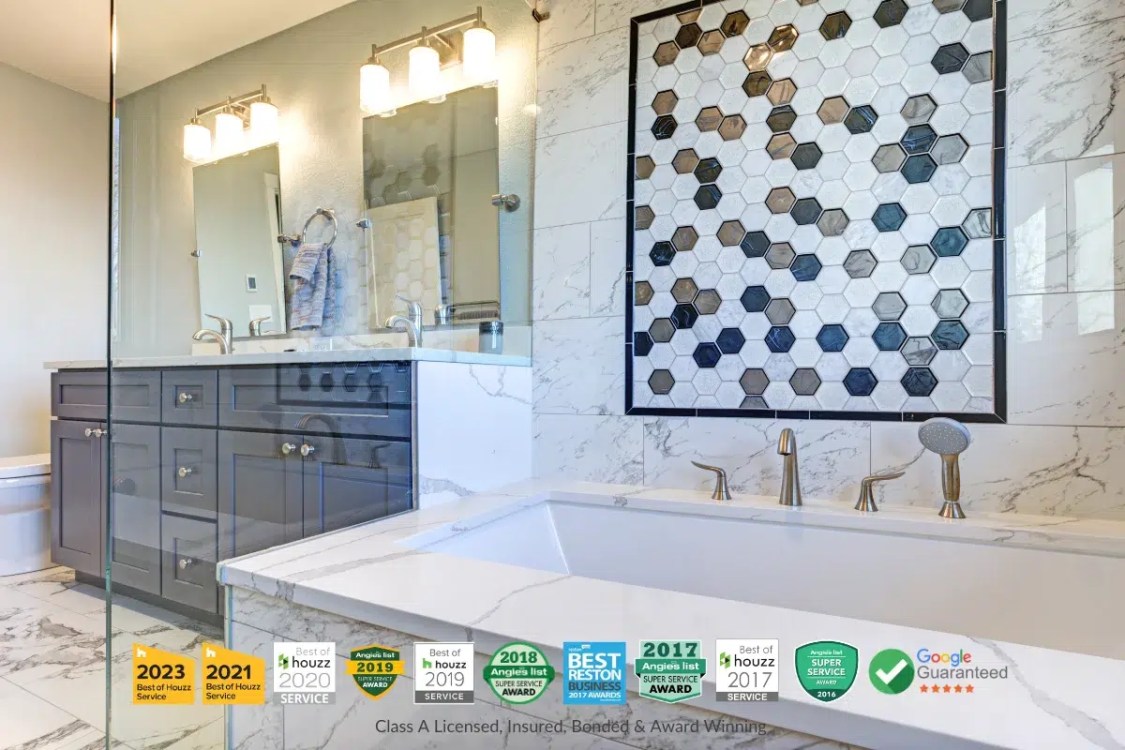
Gorgeous Trims
Trim tiles are an important part of finishing the edges and borders of your bathroom tile design. Learn more from My Kitchen & Bath.
Beautiful trim tiles can transform a bland bathroom into a stylish sanctuary. And just like embroidery on clothing or piping on a cake, trim and border tiles add just the right finishing touch. They are often a different shape or color than the field tiles they surround, defining edges with dramatic effect.
Design Advice: How to use trim tiles?
Trim tiles come in various configurations to satisfy different design requirements. The two primary categories are surface trim and radius trim. Surface trim sits on the same plane as the surrounding tiles, such as the trim around a subway tile backsplash. Radius trim is used when the setting bed wraps around a corner, such as along the edge of a countertop, around a wall corner, or where the tile meets a window.
Here’s a look at the most common trim tiles and how to use them in your bathroom tile design:
- Surface bullnose tiles have one or two glazed, rounded edges to use along the perimeters of tiled areas, creating a smooth transition between the tile and the wall.
- Radius bullnose tiles have a rounded edge that extends further than surface bullnose tiles to curve the tile around an outside corner. These are available as double radius bullnose tiles to finish shower curbs.
- Quarter rounds are a thin, curved piece that provides a transition between the tile and the wall, hiding the mud setting. You can also use them to round corners or frame out shower niches, windowsills, and undermount sinks.
- Flat liners are thin, flat trim pieces with glazed edges on the requested sides. They are an alternative to bullnose tiles or quarter rounds and are used in the same applications.
- Round liners are curved, solid trim pieces fully glazed on both sides. They can cap off edges or frame statement installations as a simpler alternative to more ornate architectural molding.
- Cove base tiles have a concavely curved edge and flat top. They are used to join bathroom wall tile and floor tile. Cove base tiles are also available in outside corner and inside corner configurations for clean edges in the corners of a room where the wall meets the floor.
- Finger cove tiles are quarter rounds glazed on the inside to provide a smooth transition between bathroom wall tile and floor tile.
- Square cap tiles have a rounded, concave edge for a smooth transition over a countertop, windowsill, or niche.
- Architectural molding is a decorative trim piece inspired by traditional architecture. It often borders tiled wainscoting or lines the top of a tiled bathroom wall where it meets the ceiling.
Are you interested in implementing these bathroom tile ideas in your home? Team up with My Kitchen & Bath for a complete bathroom renovation. Our experience serving homeowners in Vienna, VA, and the wider DC Metro area dates back to 1994. When you’re ready to turn your bathroom remodeling ideas into a beautiful, polished reality, please call us at 703-537-0857 or contact us online to request a free estimate.









1 Comment
[…] to elevate your bathroom’s design without redoing the whole space? Accent tiles and decorative trim are a great way to add personality, contrast, or a pop of color. You can use them to frame mirrors, […]